Submission by Catxi
Hack #7: v0 · v0
C
Catxi
7 May, 09:51
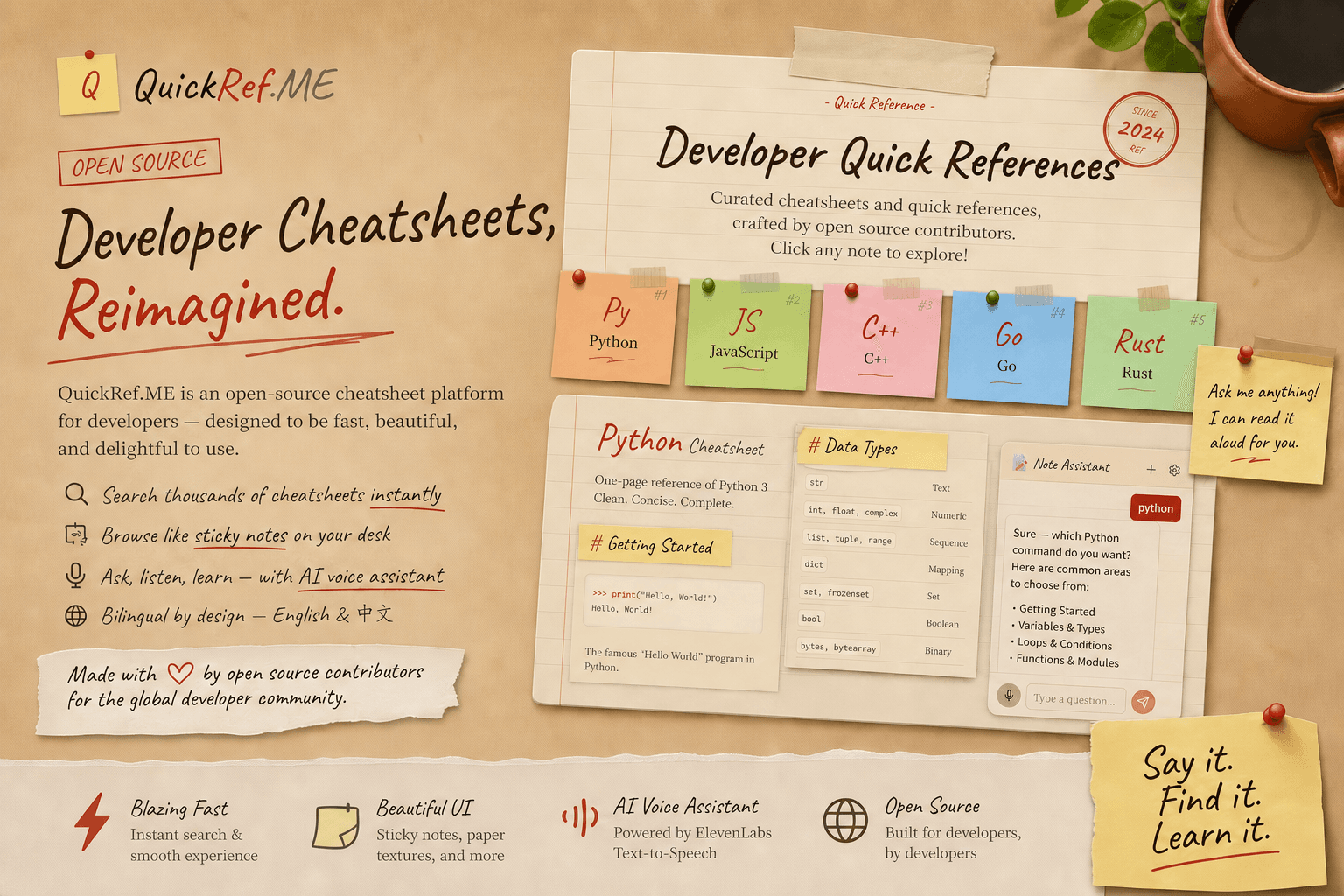
We used v0 to give the open-source cheat sheet QuickRef.ME a complete visual redesign, transforming the traditional cold, hard document list into a developer knowledge note wall with a "kraft paper + handwritten notes + stamp" style, making the tedious task of looking up commands and reading syntax feel like flipping through a notebook for taking notes. Technically, we used v0 to generate and iterate all React components and the Tailwind visual system (card rotation, paper texture, tape and pins, hover lift, detail page expansion animation, bilingual i18n switching, recent browsing history, and site-wide search) from scratch. We also used v0 to seamlessly integrate the Next.js 16 / React 19 project structure. ElevenLabs was responsible for "bringing the paper to life"—using the Sound Generation API (/v1/sound-generation) to generate paper sound effects such as page turning and tearing in real time based on prompts, and using the Text-to-Speech API (eleven_multilingual_v2 multilingual model + Rachel voice) to allow the note assistant in the lower right corner to read commands aloud in both Chinese and English. Combined with browser voice input, this creates a natural language query loop of "say a sentence, search for a command, and listen to it read it to you." What makes it special is that it is a "skin-changing" re-creation of a tool site (quickref.me) that global developers use every day—using generative AI to repackage the most familiar and rational content of engineers into a warm, tactile, and even sound physical desktop experience, proving that v0 + ElevenLabs can upgrade a plain text tool site into a multimodal product with emotional memory points.
3 participants0 audience